This column was originally featured on Newportri.com.
Every day in Newport County, behavioral health workers do more than provide care. They answer crisis calls, guide people through recovery, and often meet individuals and families at the most difficult moments of their lives. This work is both challenging and deeply meaningful, offering something few careers can: the chance to change, and sometimes save, lives in your own community.
In Newport County, there are about 269 residents for every one mental health provider, and residents report an average of 4.5 poor mental health days each month. At Newport Mental Health, we experience this need firsthand. The number of clients we serve increased 28% last year, and in March of this year, we experienced one of our most active months, with 102 people coming to us for help for the first time.
Inside this challenge is something else: a career path that is drawing people in, holding onto them, and helping them grow.
Paths Into the Behavioral Health Workforce
At Newport Mental Health, many of the people doing this work didn’t follow a straight line to get here. What they share instead is a sense of purpose, and the realization that this is where they’re meant to be.
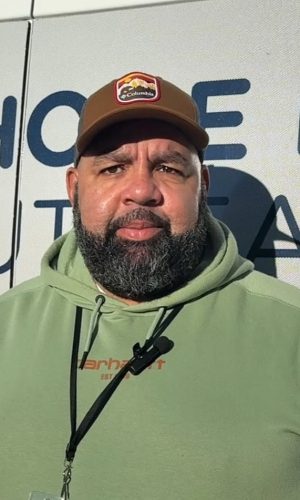
Victor Lambert, a Behavioral Health Specialist with our Rhode Island Outreach (RIO) team, has been with the organization for nearly three years. His work takes him into the community every day, meeting people in parks, at meal sites, wherever they are, and helping connect them to treatment and care.
There was a time, he says, when he couldn’t have imagined this life. After decades of struggling with substance use, he found his way into recovery and began looking for a different path. What started as a single training—a peer recovery class—shifted everything.
“By the second class, I thought, ‘this is my purpose,’” he recalls.
From there, he kept going: a Bachelor of Arts degree with honors, passing the Alcohol and Drug Counselor (ADC) exam, and becoming a Licensed Chemical Dependency Professional (LCDP). He holds CPRS, CCHW, and CADC certifications and is embarking on a journey at the Ohio State University with the goal of earning a Master of Social Work (MSW) degree and eventually a licensed Independent Clinical Social Worker (LICSW) credential.
“I was able to turn my life around and use all that lived experience to rebuild my life through recovery, and now I pay it forward to serving populations that struggle,” he says. “I just want to keep growing to better serve the community.”
Today, his work stretches across settings. In addition to his work at Newport Mental Health, he works as a behavioral health technician in a residential treatment facility, supporting individuals as they enter detox and begin early recovery. Some arrive on their own; others are referred. All are at a critical moment.
“It’s people coming in off the street, trying to detox,” he explains. “Alcohol, opioids, amphetamines … you see all of it.”
The contrast between that environment and his outreach work underscores how expansive behavioral health has become. It is not confined to one building or one role. It is a continuum of care, and a continuum of careers. What carries across all of it, he says, is connection. Having grown up in Newport, he often encounters people who already know his story, and that familiarity can open doors.
“They know where I’ve been,” he says. “That gives you a foundation of trust, and I have the empathy to help them. I know about fear, disappointment, and shame. They see it, and it disarms them a little bit, and they feel comfortable sharing things with me that they wouldn’t share with others.”
And trust, in this work, is everything. It can take weeks or months of conversations before someone is ready to accept help. “For someone to agree to treatment, it’s a huge first step.”
Exploring Career Pathways in a Growing Field
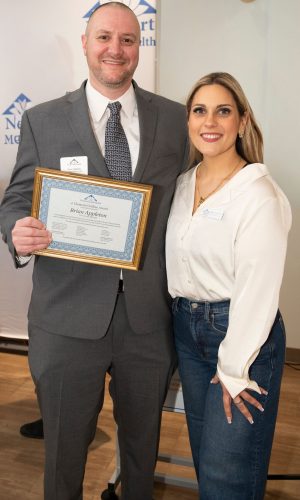
For substance use clinician Brian Appleton, that same sense of possibility is what drew him into the field, and what has kept him there.
“I’ve worked here six years,” he says about his work at Newport Mental Health. “I started as a case manager, then I did internships, and now I’m a co-occurring therapist in the Intensive Outpatient Program.”
He worked in landscaping before deciding to go back to school. He enrolled at the Community College of Rhode Island, where he earned his associate degree. He then attended Rhode Island College, completing a bachelor’s in social work and a master’s through an accelerated one-year program. He is a licensed clinical social worker (LCSW) and is working toward an LICSW.
Along the way, he balanced work, school, and family, but the structure of the field helped him keep moving forward.
Those early years in case management were formative. He spent much of his time in the community, working with clients facing a wide range of challenges from mental health conditions and substance use to housing instability and involvement with the justice system. “That’s where you really gain your experience,” he says. “Being out there, meeting people where they’re at.”
Over time, as new programs developed within the organization, including services specifically designed for co-occurring mental health and substance use disorders, he found opportunities to specialize. An internship in the Intensive Outpatient Program introduced him to group therapy, a modality he quickly connected with.
“I loved it,” he says. “You get the best of both worlds; groups and one-on-one work.” Now, in his current role, he facilitates those groups and works individually with clients navigating recovery. Like Victor, he draws on his own lived experience.
“I can tell them, ‘I’ve been where you are,’” he says. “I think it helps.” Sometimes that shared understanding is spoken. Other times, it’s simply felt. “I feel like clients can almost sense it,” he says. “Like, ‘you get it.’”
For both men, the combination of lived experience and professional training is where the work becomes highly effective. It’s also what makes behavioral health distinct as a career path. People enter from different places, bring different strengths, and develop their own styles.
“Everyone has something different they bring to the table,” Brian says. “You kind of find your own way.” There is also room to keep evolving. He’s currently focused on sharpening his clinical skills, but sees multiple paths ahead, in leadership or teaching, perhaps private practice one day. “When I started, private practice was the big goal,” he says. “Now, I’m just focused on getting better at what I do.”
That flexibility is one of the field’s defining strengths. Behavioral health is not a single job, but a network of roles and opportunities. It allows for movement between populations, specialties, and levels of care, and for growth that can unfold over years.
Why Behavioral Health Work Matters
Both clinicians acknowledge the emotional weight of the job. They talk about the importance of boundaries and self-care, and of finding ways to sustain themselves in a field that asks a lot. But they also return to the rewards.
Brian remembers a teacher asking an undergraduate class what they wanted to do in the world. “There were all these kids, and they wanted to do all these big things and change the world,” he says. “I’ll never forget what the teacher said: He said he’d never heard anyone in the class say, ‘I want to be kind.’ So that’s what I try to do. Because if you’re just kind—giving someone an extra minute or two of your time, or offering a small comment—it can change their whole day, week, or life.”
There are also bigger moments: helping someone find housing after months on the street, supporting a client through treatment, watching someone begin to rebuild their life. Victor estimates that his team alone has helped dozens of people move from homelessness into stable housing in recent years.
“When you see people really thrive in recovery, that’s where the gift is for me,” says Victor. “When someone’s utilizing all the information and the education you’re giving them to their benefit, and you see them thriving, it’s great.”
“I love it. It’s fast-paced, and every day is different,” says Brian.
In Newport County, where the need for behavioral health services continues to grow, those outcomes are both hard-won and deeply valued. They are also a reminder that behind every statistic is a person, and behind every person, a workforce that makes care possible.
Right now, that workforce needs to grow. For those considering a career change, entering the workforce, or looking for work with meaning, behavioral health offers a rare combination: demand, mobility, and purpose. There are entry points at multiple levels, from peer support roles to clinical tracks, and clear pathways for advancement through education and experience.
The advice from those already in the field is simple: start somewhere and stay open to where it can lead. “There are so many avenues to take in social work,” says Brian. “That’s why it’s great. You can work with kids, adults, or the elderly. You can teach; there are many different things you can do.”
In a community like Newport, where the need is visible and the impact is immediate, that realization can turn into a career that not only supports a livelihood, but shapes a life.
And for many, that’s what makes the work worth it.
Dayna Gladstein is President & CEO of Newport Mental Health in Middletown. Peace of Mind, which is co-written with Kristan McClintock, runs in the Newport Daily News and online at newportri.com.